Skip to content

75 posts tagged with “history”

As a longtime Apple fanboy, it’s a little hard for me to appreciate the visual design of Windows—Microsoft is a nemesis, if you will. But I will tip my hat to the design practitioners there who’ve made the company finally pay attention to design.

Side note, reminds me of a story about what Steve Jobs once told me when I was designing the welcome animation for Mac OS X.

Screenshot of a Windows desktop

A glimpse into the history of Windows design

At the turn of the millennium, the widespread adoption of Microsoft Windows was a pivotal moment in technology. It played a crucial role in the integration of personal computers into both business and home environments. Windows introduced features that revolutionized network management and enhanced support for mobile computing, paving the way for the modern, connected workplace. Harold Gomez, Jeremy Knudsen, and Kim Sealls are three designers at Microsoft who have contributed to Windows design since 2000 and witnessed its design evolution. From the iconic Windows XP to the sleek Windows 11, Windows has constantly evolved to reflect the changing needs and preferences of users worldwide. In this roundtable discussion, we delve into the remarkable journey of Windows design.

microsoft.design iconmicrosoft.design

Related to the NYT article about Gen X-ers in creative industries that I posted yesterday, graphic design historian Steven Heller explores what happened with advertising—specifically print—creative in the 2000s.

Advertising did not change when the Times Square ball fell at the stroke of midnight on Jan. 1, 2000, but the industry began its creative decline in the early 2000s. Here are several indicators to support this claim: For one, the traditional print outlets for advertisements, notably magazines and newspapers, sharply declined in numbers (some turning to digital-only) during the late 1990s and early 2000s. Major advertisers were cutting print budgets and earmarking creative talent for television work. TV had already plucked away many of the most imaginative ad-people during the preceding decades, and print slipped lower down on the hierarchical ladder.

He continues:

The work of 1960s and 1970s “mad men” smothered conventional establishment agencies at Art Directors Club award competitions, spawning the innovative Big Idea creative dynamic where exceptional art directors and copywriters made witty, ironic and suggestive slogans and visuals. But, by the early 2000s, these teams started to cede their dominance with, among the other social factors, the death of many national print magazines and the failure of television networks to retain large audiences in the face of cable.

In my first couple of years in design school, I was enamored with advertising. It seemed so glamorous to be making ads that appeared in glossy magazines and on TV. I remember visiting the offices of an agency in San Francisco—the name escapes me—and just loving the vibe and the potential. After graduation and into my career, I would brush up against ad agencies, collaborating with them on the pieces my design company was working on. Sometimes it was with FCB on Levi’s retail work, or BBDO for Mitsubishi Motors digital campaigns. I ended up working for a small ad agency in 2010, PJA Advertising & Marketing, doing B2B ads. It was fun and I learned a lot, but it wasn’t glamorous.

Anyway, back to Heller’s article…it’s reinforcing the idea that our—potentially Boomers, Gen Xers, and even Millennials—mental model of the creative and media world must change due to reality. And we must pivot our careers or be left behind.

preview-1743628868066.jpg

The Daily Heller: The Beginning of the End of Print Advertising? – PRINT Magazine

Taschen's All-American Ads series tells a distinct history of the United States from various vantage points.

printmag.com iconprintmag.com

Retro Safety

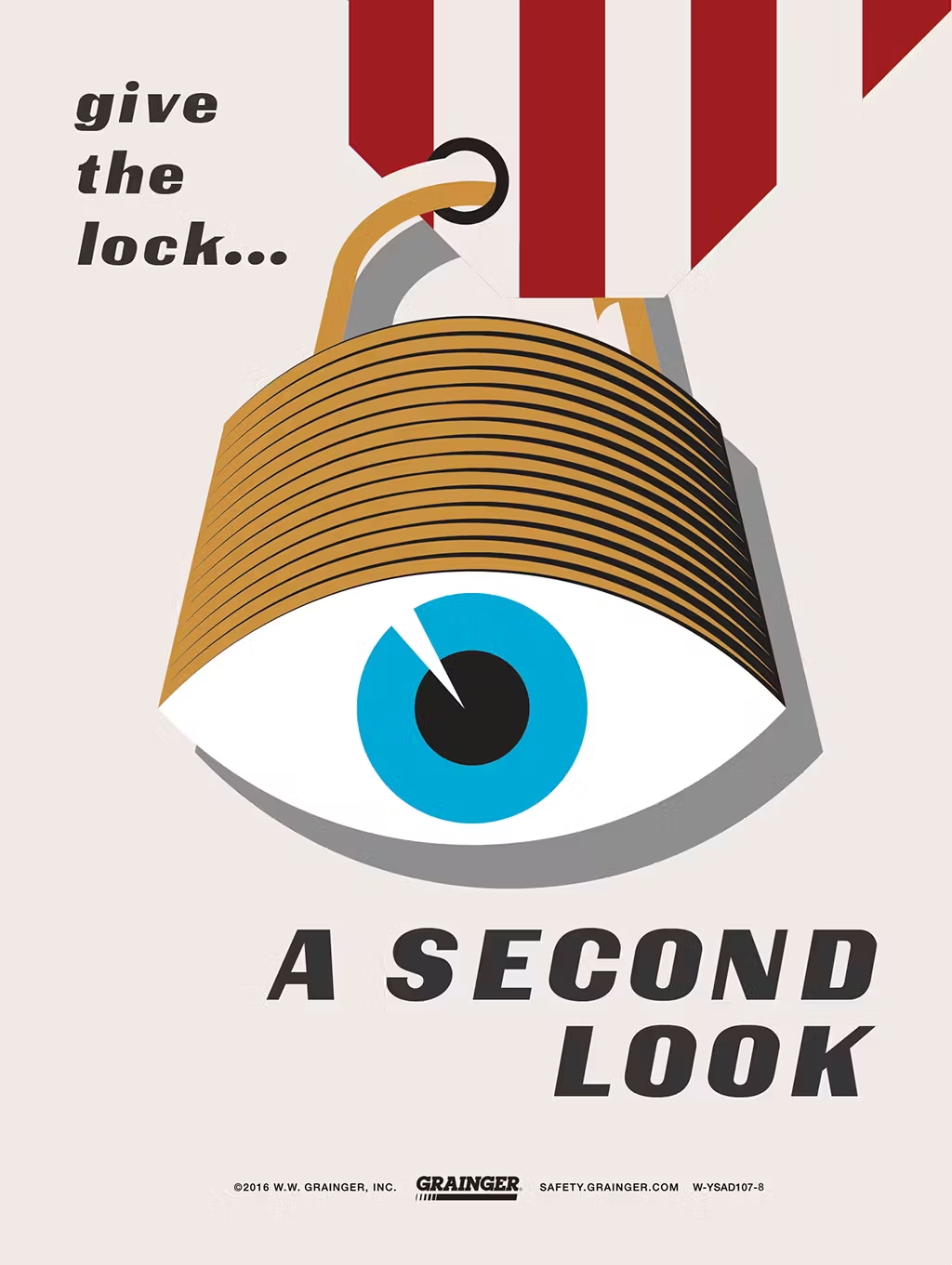
I was visiting a customer of ours in Denver this week. They’re an HVAC contractor and we were camped out in one of their conference rooms where they teach their service technicians. On the walls, among posters of air conditioning diagrams were a couple of safety posters. At first glance they look like they’re from the 1950s and ’60s, but upon closer inspection, they’re from 2016! The only credit I can find on the internet is the copywriter, John Wrend.

Sadly, the original microsite where Grainger had these posters is gone, but I managed to track down the full set.

Illustration of a padlock shaped like a human eye with text that reads “give the lock… A SECOND LOOK,” promoting safety awareness from Grainger.

A stylized digital illustration of a person reclining in an Eames lounge chair and ottoman, rendered in a neon-noir style with deep blues and bright coral red accents. The person is shown in profile, wearing glasses and holding what appears to be a device or notebook. The scene includes abstract geometric lines cutting across the composition and a potted plant in the background. The lighting creates dramatic shadows and highlights, giving the illustration a modern, cyberpunk aesthetic.

Design’s Purpose Remains Constant

Fabricio Teixeira and Caio Braga, in their annual The State of UX report:

Despite all the transformations we’re seeing, one thing we know for sure: Design (the craft, the discipline, the science) is not going anywhere. While Design only became a more official profession in the 19th century, the study of how craft can be applied to improve business dates back to the early 1800s. Since then, only one thing has remained constant: how Design is done is completely different decade after decade. The change we’re discussing here is not a revolution, just an evolution. It’s simply a change in how many roles will be needed and what they will entail. “Digital systems, not people, will do much of the craft of (screen-level) interaction design.”

Scary words for the UX design profession as it stares down the coming onslaught of AI. Our industry isn’t the first one to face this—copywriters, illustrators, and stock photographers have already been facing the disruption of their respective crafts. All of these creatives have had to pivot quickly. And so will we.

Where are the Black Designers

Representation Is Powerful

This was originally published as an item in Issue 004 of the designspun email newsletter.

When I went to design school in the 1990s, of course, graphic design history was part of the curriculum. I didn’t realize it at the time, but everyone we studied—and therefore worshipped—was a white male. For minorities, representation is so powerful. And as the conversation in our country about race righteously heats up and expands from police brutality to systemic racism, it’s time to look at our own industry and ask ourselves about diversity and representation.

Toronto-based creative director Glenford Laughton compiled a great list of 13 African-American graphic designers we should all know. It includes greats like Georg Olden, who was the first African American to design a postage stamp, and Archie Boston, the designer-provocateur who started and chaired the design program at Cal State Long Beach.

30 Years of Mac

The Apple Mac turned 30 years old today. I got my first Mac in 1985 actually after weeks if not months of convincing my father to spend his hard-earned money on it. Every weekend and after many school days, I’d take the bus over to Computerland on Van Ness in San Francisco and just play with the Mac on display for hours at a time.

Embarrassingly this is one of my first MacPaint paintings. Bear in mind that I was 12 years old at the time.

Black-and-white pixel art titled “SUNSET” by Roger Wong, dated August 17, 1985, depicting a stylized landscape with mountains, trees, a setting sun, and textured foreground patterns.